 DSA Signage
Ranking the World’s Most Cost-Efficient Digital Billboards

To determine where attention is most expensive, DSA Signage conducted a comparative analysis of the world’s most prominent outdoor digital advertising locations. To make these differences comparable, this analysis focuses on one key metric: cost per 1,000 viewers (CPM). Rather than counting how many people pass by, this metric reflects how much advertisers actually pay for actual audience exposure, based on how many people are likely to see a screen.
Alongside the CPM core metric, the study incorporates three core inputs: daily footfall, estimated media share (how visible a screen is compared to competing billboards), and daily cost. Together, these are used to calculate effective daily contacts and standardized ad pricing, so all locations can be compared on the same basis.
The result is a Global Signage Attention Benchmark: a comparison of the price of attention across leading outdoor advertising locations, revealing where visibility is most and least efficient.
Key Findings at a Glance
- Cost per 1,000 views varies by more than 60× across locations worldwide.
- Shinjuku, Tokyo, records the lowest cost per 1,000 viewers in this study, where a high-traffic environment and 3D display format combine to maximise attention capture.
- Reaching 1,000 people in Western landmark locations like Times Square and Piccadilly Circus is typically more expensive than in comparable Asian locations.
- Seoul’s K-POP Square Media Wall records the highest media share in the dataset, driven by low visual competition within the square.
1. Tokyo – Cross Shinjuku Vision
Located at the East Exit of Shinjuku Station in Shinjuku, this 3D LED screen has become one of Tokyo’s most recognizable media landmarks. It is positioned in a dense pedestrian flow where commuters, shoppers, and tourists intersect, 400,000 people per day on average. First introduced in the summer of 2021, the Cross Shinjuku Vision is a unique display that continues to capture the attention of tourists and locals alike. Unlike networked installations, it operates as a single dominant screen, competing with only a handful of nearby displays. Its strength lies in its clarity and isolation: it stands out in a highly active but relatively fragmented visual environment.
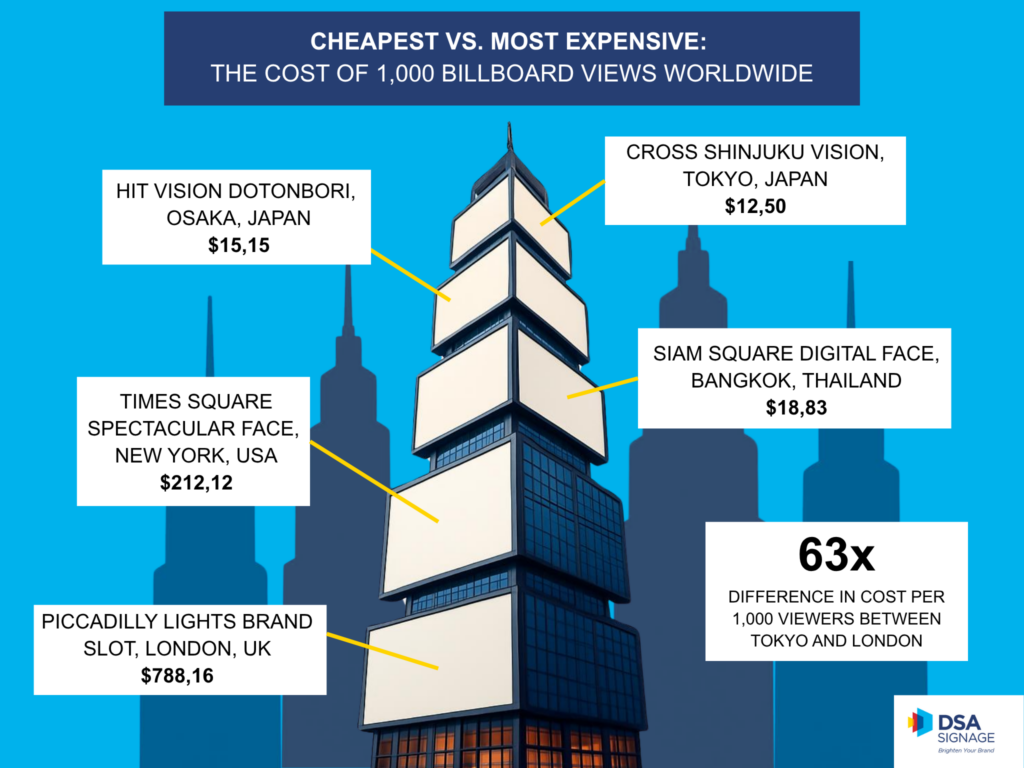
At $1,000 per day, this screen ranks among the most affordable advertising placements globally. A 30-second slot is priced at $41.67, and at just $12.50, it offers the lowest cost per 1,000 viewers worldwide. Even after accounting for shared screen exposure, where each ad receives an estimated 20% share of screen time alongside 5–6 competitors, a single campaign still reaches an estimated 80,000 viewers per day.

2. Osaka – Hit Vision Dotonbori
Situated along the Dotonbori Canal area, this screen is embedded in one of Osaka’s busiest entertainment districts. The location is surrounded by restaurants, nightlife, and tourist foot traffic, resulting in a near-constant flow of pedestrians. Despite competing signage, the sheer size of Hit Vision Dotonbori ensures it stands out. The installation covers roughly 4,900 square feet across two screens. Similar to Cross Shinjuku Vision in Tokyo, it enables naked-eye 3D, turning campaigns into striking visual landmarks.
Hit Vision Dotonbori taps into one of Osaka’s busiest pedestrian hotspots, with around 660,000 people passing by each day. Even with a medium media share of 15%, that translates into roughly 99,000 estimated daily viewers. At $1,500 per day, the placement delivers a CPM of $15.15, ranking second globally in cost efficiency, while 30-second spots are priced at $62.50.
3. Bangkok – Siam Square Digital Face
Located in the commercial heart of Siam Square in Bangkok, this façade screen is part of a modern retail and entertainment cluster. The area attracts a mix of local shoppers, young professionals, and tourists, with high dwell time compared to transit-heavy environments. The screen benefits from relatively lower media saturation compared to cities like Tokyo or New York, allowing for a stronger individual media share within its immediate surroundings.
As a result, Siam Square Digital Face reaches approximately 200,000 people daily and generates around 40,000 effective daily viewers at a medium media share of 20%. With a daily cost of $753, it delivers the lowest entry price in the portfolio, including 30-second spots at $31.38, and achieves a CPM of $18.83, ranking third globally in cost efficiency.

4. Hong Kong – Nathan Road Digital Face
Nathan Road in Tsim Sha Tsui functions as one of Hong Kong’s most intense commercial arteries, where retail façades, signage, and pedestrian traffic merge into a continuous visual environment. Within this setting, the screens from Nathan Road Digital Face are exposed to an estimated 250,000 passersby per day, though the density of competing advertising surfaces reduces individual prominence, resulting in a 15% media share and approximately 37,500 effective daily viewers. At a daily cost of $1,000, the placement achieves a CPM of $26.67, with 30-second spots priced at $41.67.

5. Seoul – K-POP Square Media Wall
In Seoul’s Gangnam district, the K-POP Square Media Wall forms part of the COEX Complex, often referred to as the “Times Square of Seoul”. The installation is built into a large curved LED façade that wraps around the building, transforming the exterior into a continuous digital surface overlooking a public plaza. As the name suggests, this space is frequently used for events, fan gatherings, and brand activations tied to Korea’s entertainment industry.
Within this high-profile environment, the screen benefits from an estimated 125,000 daily passersby and stands out through its large-scale curved design and relatively low visual competition within the square. It achieves a high media share of 50%, the highest among all locations analyzed, allowing it to concentrate attention more effectively. Compared to more fragmented urban corridors, this results in around 62,500 estimated daily viewers. At $2,433 per day, the placement delivers a CPM of $38.93 and a 30-second spot cost of $101.38, reflecting its premium visibility within one of Seoul’s most culturally prominent media locations.

6. Las Vegas – Strip Digital Face
Las Vegas is known worldwide for its glittering lights and larger-than-life signage, where the city itself becomes a continuous visual spectacle. On the Strip, advertising screens operate within one of the most saturated media environments globally, surrounded by casinos, LED façades, and entertainment displays competing for attention at every angle. While approximately 400,000 pedestrians pass through the area each day, visibility is heavily fragmented across this dense visual landscape, resulting in an estimated 15% media share and around 60,000 daily viewers for the Strip Digital Face. Within this context, the placement operates at a daily cost of $2,500, with 30-second spots priced at $104.17, and a CPM of $41.67, reflecting both the scale and intensity of the surrounding environment.

7. Tokyo – Shibuya Synchro Network
Shibuya Crossing is one of the most famous pedestrian intersections in the world, where thousands of people pass through every day. Directly opposite the Hachikō Statue, a well-known meeting point and cultural landmark, visitors gather, wait, and orient themselves before entering the flow of the intersection. Importantly, Shibuya is also one of the most photographed urban intersections in the world. Many visitors record the crossing experience and share it across social media platforms, extending on-site impressions into global exposure. In this way, advertising content displayed within the network has a higher likelihood of extending beyond the physical location through user-generated amplification.
Within this setting, the Shibuya Synchro Network operates not as a single screen but as a synchronized system of multiple displays showing identical content across different angles of the crossing. The effect mirrors the movement of the crowd itself: fragmented from a distance, but unified in motion at ground level. With an estimated 400,000 daily passersby and a medium 40% media share, the network generates approximately 160,000 estimated daily viewers. At $15,000 per day, it delivers a CPM of $93.75, with 30-second spots priced at $625.

8. Shanghai – Nanjing Road East 1088 LED
Nanjing Road East is widely regarded as one of the busiest retail corridors in the world, where pedestrian traffic reaches extremely high volumes, and commercial activity extends continuously along the street. The Nanjing 1088 LED Screen is embedded in this high-density environment, surrounded by layered storefronts, large-scale branding, and competing digital signage that collectively shape a highly saturated visual field.
While the location offers exceptional exposure potential with an estimated 1,000,000 daily passersby, attention is heavily fragmented across the surrounding media landscape. As a result, the screen operates with the lowest media share in the portfolio at 10%, translating into approximately 100,000 effective estimated viewers. At a daily cost of $10,200, this results in a CPM of $102, with 30-second spots priced at $425.

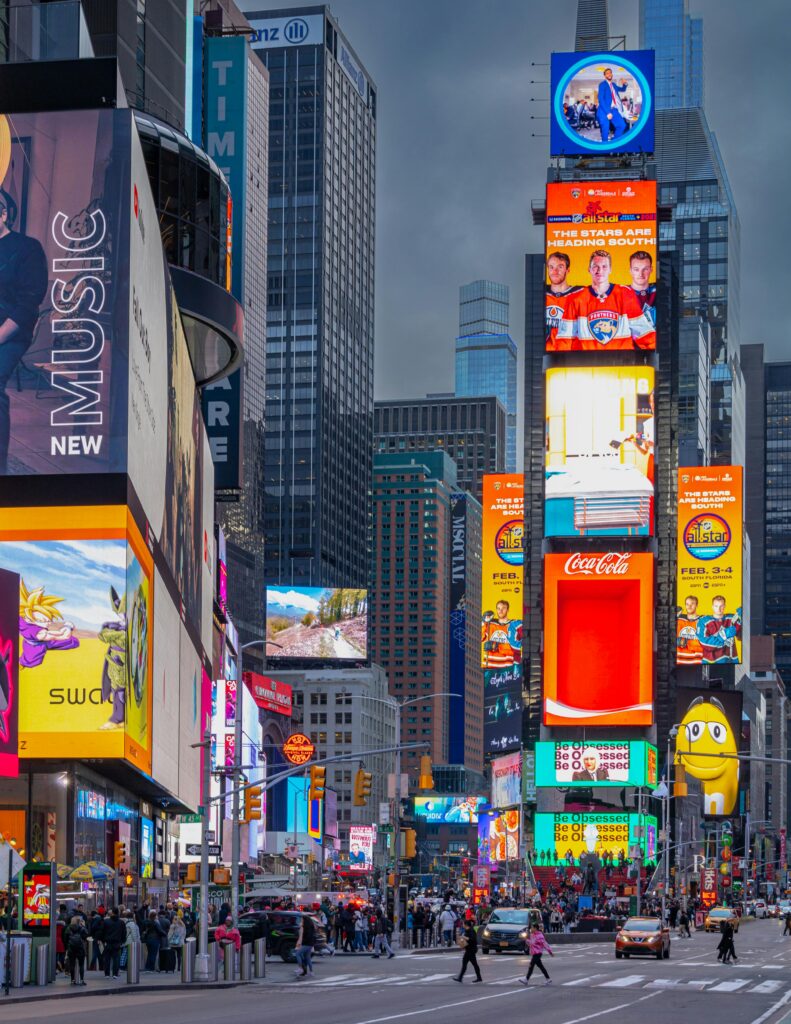
9. New York – Times Square Spectacular Face
New York’s Times Square is well known around the world, with its dazzling, high-energy intersection defined by massive digital billboards and bright lights. As one of Midtown Manhattan’s busiest and most iconic public spaces, it attracts millions of visitors each year and operates as a 24/7 center of movement, entertainment, and media exposure. The visual environment is famously intense, with layers of a dense, neon-saturated aesthetic and high-energy atmosphere that reflect the city’s broader media culture.
Among the dense cluster of LED façades, the Spectacular Face is a large-format, multi-story digital display wrapped around a corner building, allowing it to capture visibility from multiple angles within the intersection. Although foot traffic is substantial at around 220,000 people per day, visibility is inherently fragmented due to the density of surrounding screens and large-format installations. This results in an estimated 15% media share and approximately 33,000 daily viewers for the Times Square Spectacular Face. At a daily cost of $7,000, the placement reflects its premium positioning, with 30-second spots priced at $291.67 and a CPM of $212.12. In this context, value is driven less by efficiency and more by symbolic presence in one of the world’s most culturally charged media spaces.
10. London – Piccadilly Lights Brand Slot
Piccadilly Circus functions as a central junction where several of London’s key pedestrian and transport flows converge, connecting major retail streets, entertainment districts, and underground transit lines. The intersection is designed around continuous movement, with large volumes of people passing through rather than remaining in place, which creates repeated but brief exposure opportunities to the surrounding digital façades.
Within this environment, Piccadilly Lights Brand Slot operates as a shared digital canvas using a rotational format in which multiple advertisers are displayed sequentially on the same surface. Although the junction receives approximately 274,000 people per day, exposure is distributed across time slots and competing content, limiting sustained visibility for any single campaign. This results in an estimated 17% media share and around 45,676 daily viewers. At a daily cost of $36,000, the placement achieves a CPM of $788.16 and a 30-second equivalent cost of $1,500, making it the least efficient unit in the portfolio in terms of cost per 1,000 viewers.

Methodology: How We Created the Global Signage Attention Benchmark
The Global Signage Attention Benchmark evaluates 10 high-traffic outdoor advertising locations using a single efficiency metric: cost per 1,000 visible contacts (CPM). All locations are assessed using an identical unit of purchase and a standardized adjustment for visibility. The objective is to isolate differences in cost efficiency under comparable conditions. All locations are then ranked by CPM, from most to least efficient.
To ensure comparability across very different cities and formats, each location is evaluated under a standardized model:
- One 30-second ad spot
- Runs once per hour
- 24 times per day (standard daily buy)
- Cost based on publicly available operator rate card
- Adjusted for estimated visibility share (how much of the passing audience actually sees the screen)
The Global Signage Attention Benchmark is based on three core inputs:
- Daily Footfall: the number of people passing a screen’s primary sightline on a typical day
- Media Share: the proportion of that audience estimated to actually see the screen
- Daily Cost: the price of a standardized 24-hour advertising buy
From these inputs, the following metrics are derived:
- Cost per 1,000 viewers (CPM): the cost of reaching 1,000 people who actually see the screen
- Cost per 30-second spot: the unit price of a single ad placement
- Effective Daily Viewers: the estimated number of real viewers per day
A more detailed explanation of the methodology is available here.
About DSA Signage
Learn more about DSA’s digital signage solutions, explore industries served, or request a quote.